The world does not
need our belief
to keep turning.
An experiment gives us a way to test what seems obvious.
A pendulum.
A proof.
A moving Earth.
In 1851, Léon Foucault made Earth’s rotation visible through a swinging pendulum. A point beneath the weight marked a bed of sand. The marks shifted relative to the ground.
In Berlin, an ideal Foucault pendulum would turn its swing plane relative to the floor by only about three degrees in fifteen minutes. The rotating stage makes that changing relationship perceptible on the scale of a performance.
Here, a turning stage brings Foucault’s idea into the time of a performance. The swing follows T = 2π√(L/g); Irena’s drawn body yields to the movement. Physics becomes a starting point for imagining.
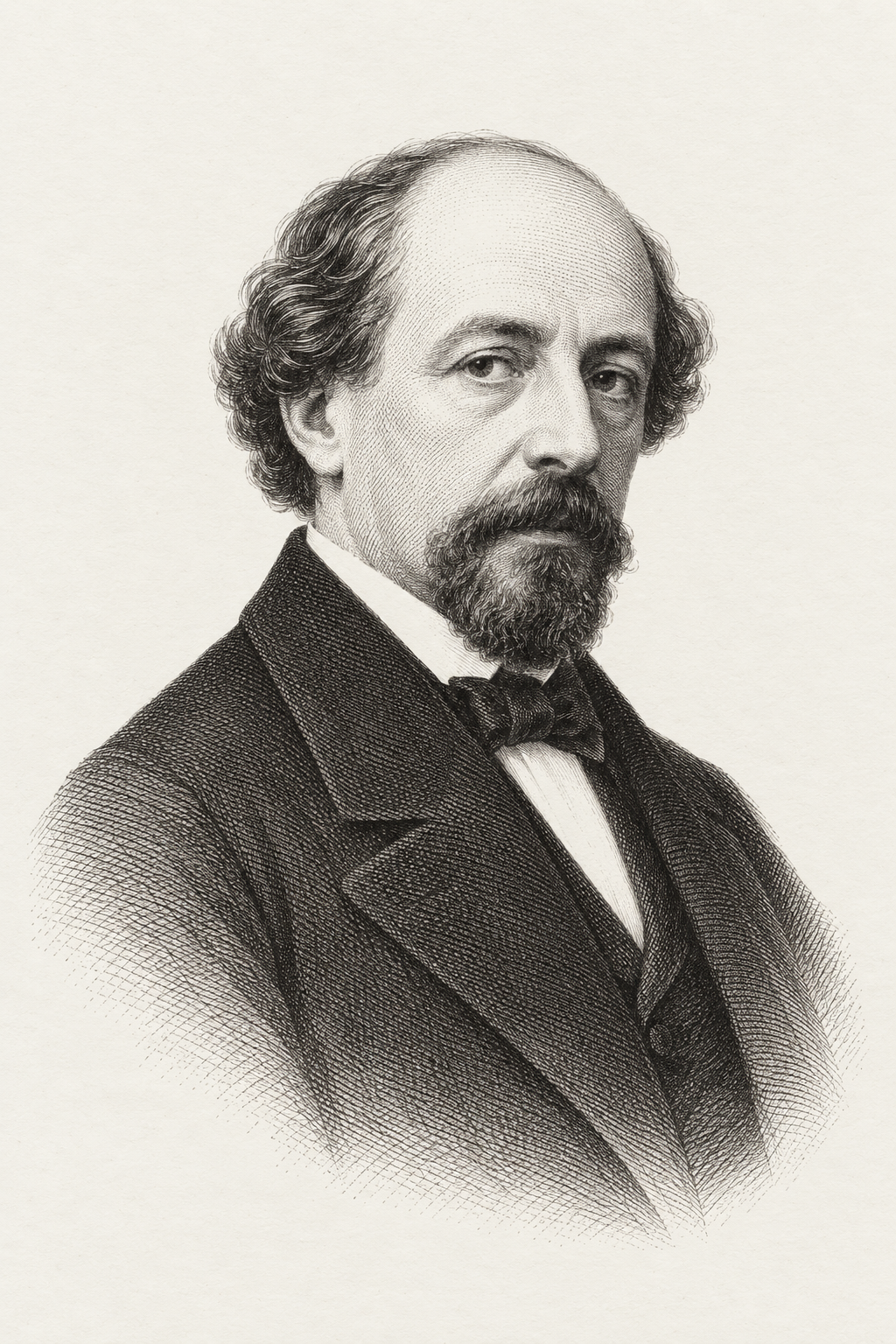
FOUCAULT, Léon.
1819–1868 · French physicist
In 1851, Foucault demonstrated the rotation of the Earth with a freely swinging pendulum. Beneath the apparent constancy of the ground lay a motion the eye could not directly perceive.
The instrument did not ask for belief. It made a relation observable: a swinging weight, a turning world, and the difference between their motions.
Biography · University of St AndrewsTwo ways
to measure time.
The pendulum returns. The hourglass spends.
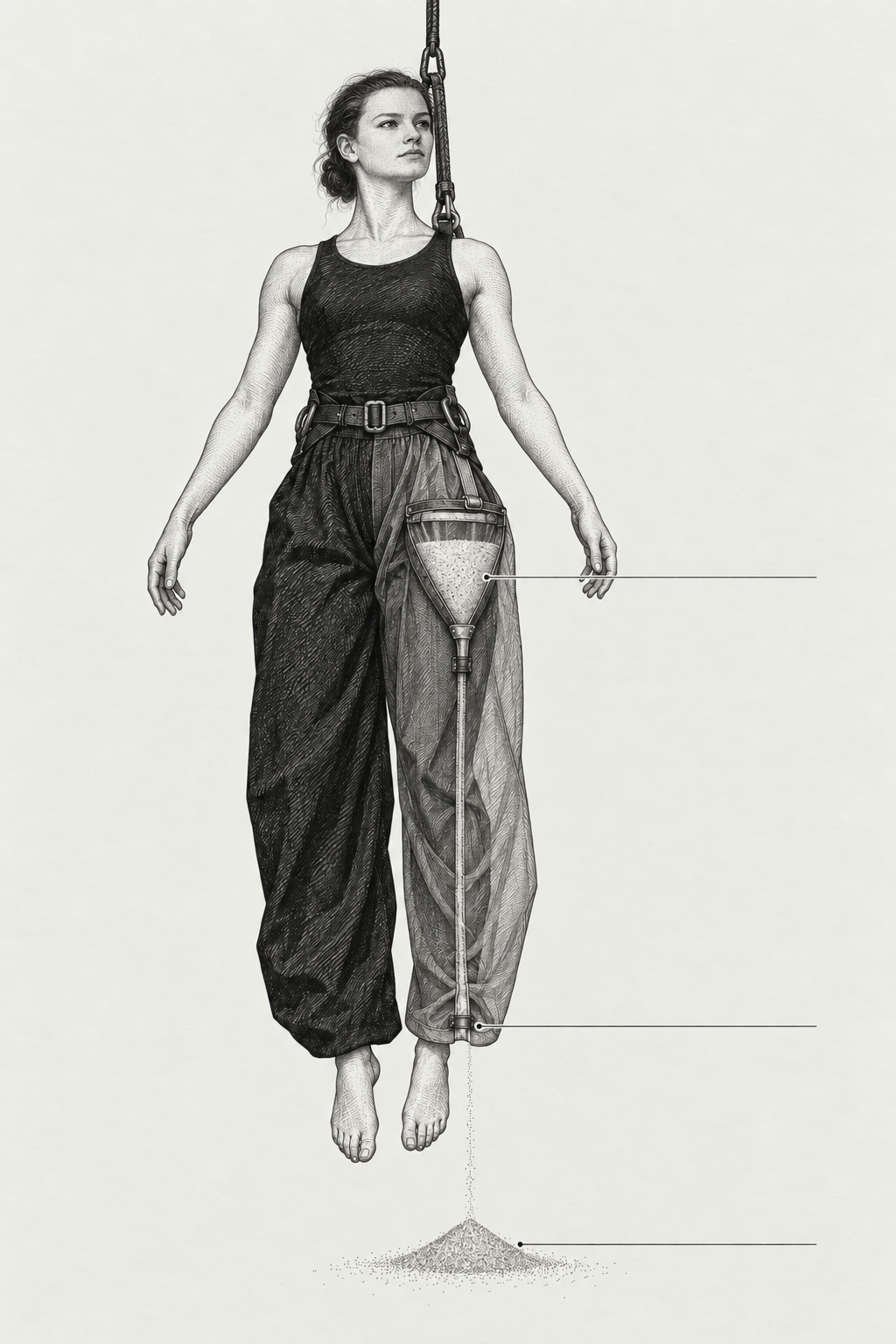
Both are instruments of time. A pendulum measures duration by counting repeated swings. An hourglass measures it through a finite supply passing at a calibrated rate. The body begins with 8 kg of sand: approximately 214 million grains, assuming quartz grains 0.3 mm across. At 30 grams per second, the reserve lasts four minutes and twenty-seven seconds. For a fifteen-minute performance, the average flow would be about 8.9 grams per second. Each visible particle represents many grains; the reserve drains by mass.
As the drawing gains weight, Irena loses it. Closing the outlet stops the material clock while the swing continues. Reopening it lets the two measures run together again. A repeated movement can be counted indefinitely; this particular supply can only be spent once.
Try four times the pendulum length in the experiment: the period doubles. The drawing uses an enlarged, constant-width swing for visibility; its timing follows the ideal formula. Changing length or stage period preserves the existing trace.
The two clocks agree only while we choose how to count.
A body becomes
the question.
A fifteen-minute performance
in development.
Denying
the Obvious
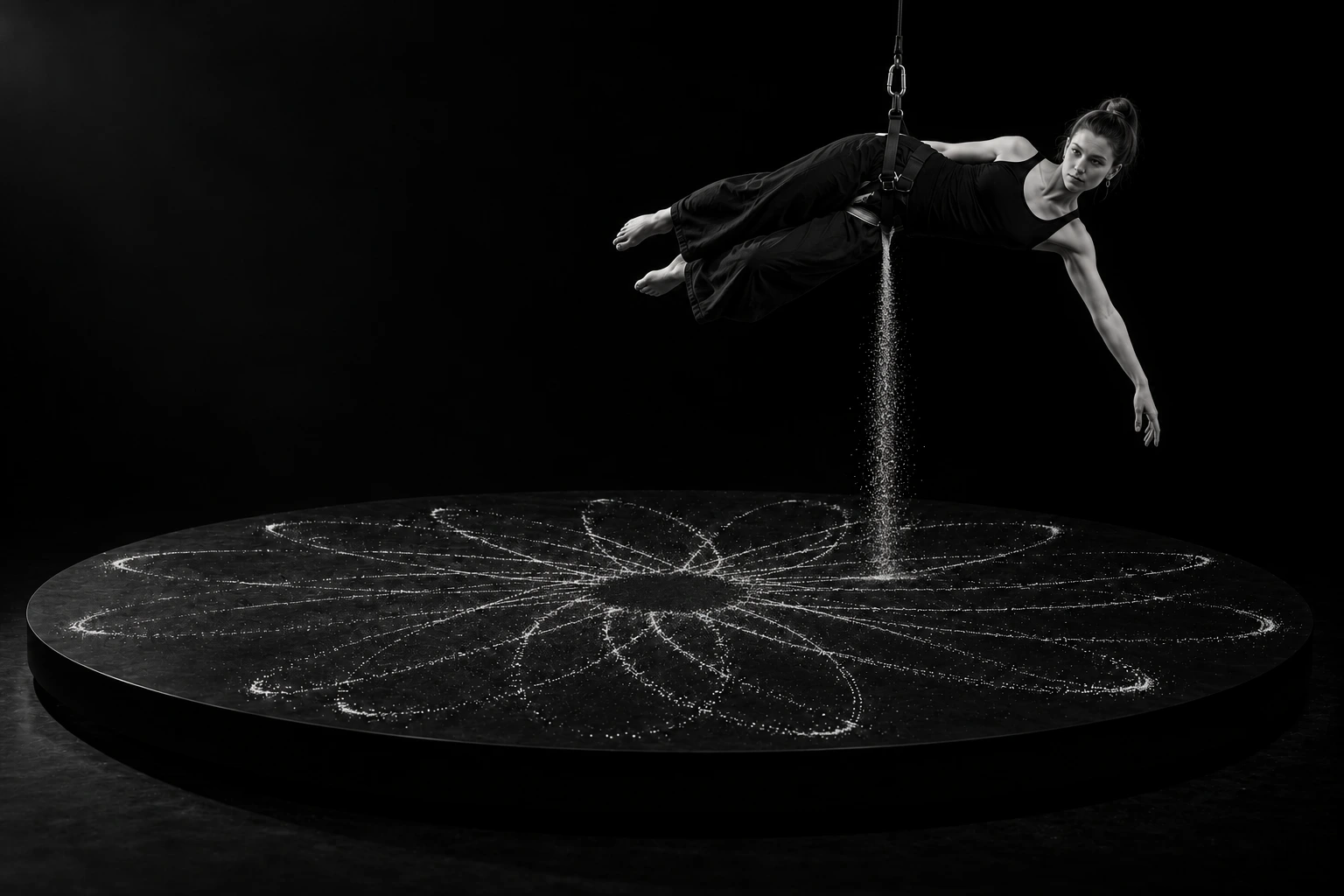
A dancer hangs above a slowly turning floor. Sand falls from a container within her trousers. She tries to make the same line again.
Her task is simple: return to the same place. But which place—the point in the room, the position on the floor, or the mark she left before? As the stage turns, those answers pull apart.
She tests each answer with her body. Sometimes she corrects her path; sometimes she lets the floor carry the mark away. Closing the outlet gives her a movement that belongs only to those watching.
Inspired by a visit to Maxim Gorki Theater in Berlin, and by the suspended relationships in Togetherness. A project by Irena Wiktor and Rafał Korzeniowski; the movement language will develop through rehearsal.
A body carries
its own time.
A section through the trousers reveals the sand reservoir. The costume carries both a weight and the means to release it.
- The reserve. A finite supply held inside the garment.
- The choice. A controllable outlet: recording can be withheld.
- The remainder. A drawing made from what the body lets go.
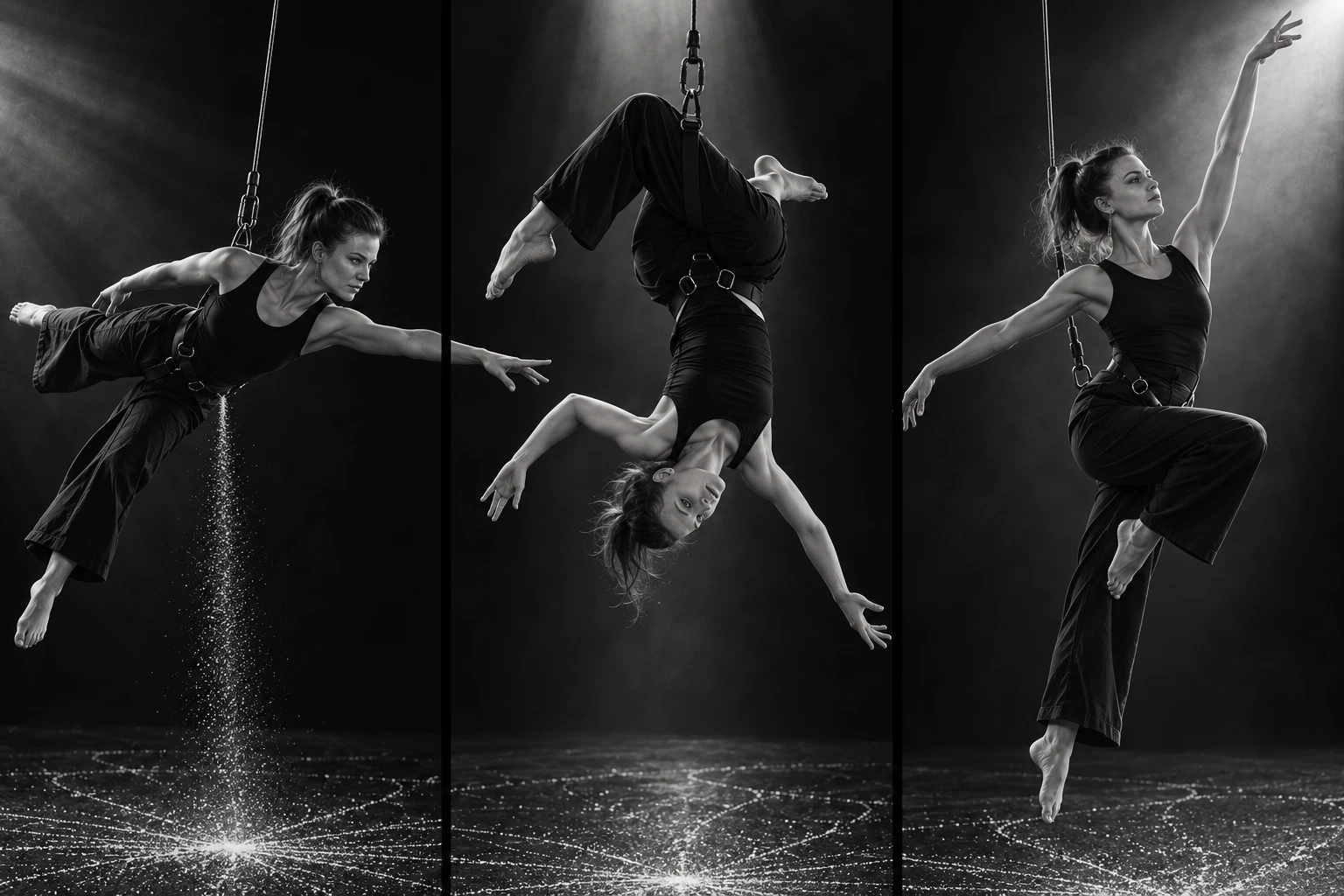
Fifteen minutes.
Seven changes.
Open a moment to enter the score.
00:00 — 01:30A reference
The floor is still. A low suspended body makes small shifts of weight. Sand stays inside the trousers. We notice the support before the feat.
Still floor · closed flow · breath01:30 — 03:00One line
A modest repeating swing begins. Irena releases the sand. Several passages fall along roughly the same path. The audience learns the relation between an action and its mark.
Still floor · open flow · repetition03:00 — 05:30The ground changes
The floor turns slowly. The phrase continues, but its traces separate. The first mark and a fixed line of light no longer agree. We may notice the change before she does.
Turning floor · open flow · divergence05:30 — 08:00An attempted return
She tries to recover an old mark. Every small correction produces a new difference. Her attention becomes more exact, rather than more frantic. What does it mean to do the same thing?
Adjustment · attention · imperfect return08:00 — 10:30The right to disappear
She chooses to close the sand outlet. Motion continues. A brief inversion may belong here, with no sand falling, if it becomes part of her movement language. The drawing misses an event we have witnessed.
Closed flow · continuing body · chosen silence10:30 — 12:30Reversal without repair
The floor slows, stops, then changes direction. The sand resumes. Even where a passage retraces an old line, it adds material. Changing direction cannot put fallen sand back into the trousers.
Reversing floor · open flow · accumulation12:30 — 15:00After the instrument
The finite supply ends. She continues. The floor comes to rest. After the last grain, one small new gesture asks whether we can keep watching when nothing more is being produced.
Empty reservoir · living body · unfinished imageA first score, open to discovery. Its rhythm and movement will take shape through rehearsal with Irena.
What else
is at stake?
A changing home
A person repeats an action. The coordinates used to judge it have moved. Displacement can happen without departure.
An incomplete archive
A record preserves some things and excludes others. Choosing when to release the sand is also choosing what future viewers will be able to know.
An impossible return
Returning to an earlier position does not restore an earlier relationship. What would repair require beyond reversing direction?
A life beyond output
When the supply is spent, there is no new drawing to reward our attention. Can we stay with a person who is no longer producing anything?
Nothing begins
from nowhere.
Research is part of the work.
Gorki, Berlin
A theatre whose history includes its origins in 1952 and its later postmigrant work offers a compelling setting for a piece about changing frames. The current 2026/27 chapter begins under Çağla Ilk.
An especially close precedent was already shown here: Danica Dakić’s Zenica Trilogy, presented at Gorki in 2023. In Scena / The Stage, a woman runs against a revolving stage without advancing. This proposal takes a different question into rehearsal: who controls the record, and what can survive outside it?
Gorki · history2026/27 transitionGorki · Zenica TrilogyDakić · Scena